

Boom vs. Arm vs. Bucket Cylinder: How Excavator Hydraulic Cylinder Sizing Actually Works
Boom vs. Arm vs. Bucket Cylinder: How Excavator Hydraulic Cylinder Sizing Actually Works
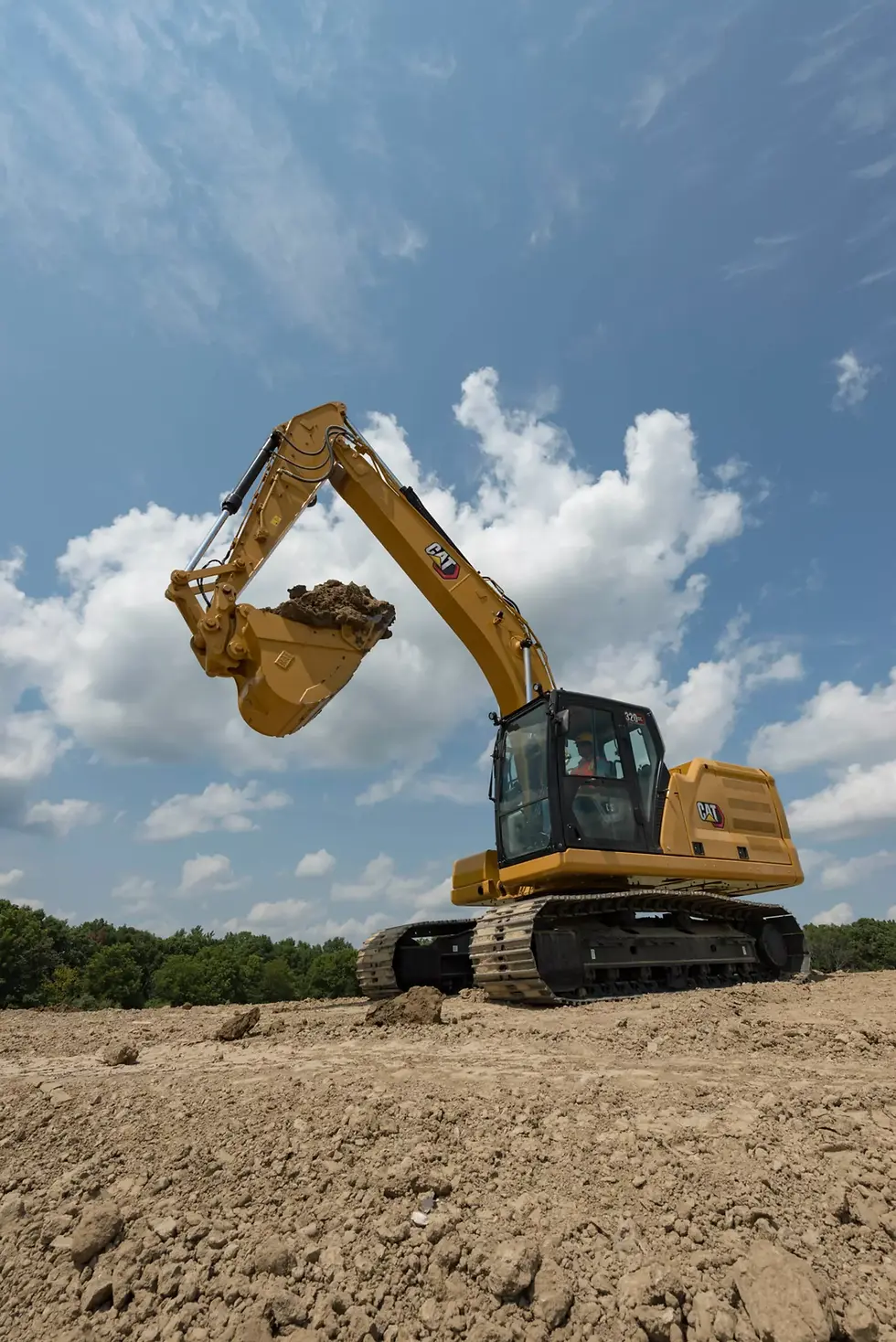
Three hydraulic cylinders do essentially all the work on a standard excavator front end, and from fifteen feet away they look like three versions of the same part: a steel tube, a chrome rod, and a pair of mounting eyes. Up close, and on the spec sheet, they're sized completely differently from each other, because each one is solving a different leverage problem. On a CAT 320, for example, the boom cylinder runs a 120 mm bore on a 1,260 mm stroke, the arm (stick) cylinder runs a 135 mm bore on a 1,504 mm stroke, and the bucket cylinder runs a 115 mm bore on a 1,104 mm stroke. Those three numbers aren't arbitrary, and understanding why they differ tells you a lot about how an excavator actually generates digging force.
The Boom Cylinder: Lifting the Whole Front End
The boom cylinder's job is the simplest to describe and, in some ways, the hardest mechanically: lift and hold the entire front end, arm, bucket, and whatever material is in the bucket, against gravity, continuously, for the entire work shift. It operates at a relatively long stroke because the boom pivots through a wide arc, and it needs real bore diameter because holding a loaded bucket at full reach, the single highest-leverage position on the whole machine, demands serious sustained force rather than a quick burst.
Because the boom cylinder is doing continuous holding work rather than rapid cycling, it's also the cylinder most dependent on a healthy counterbalance or holding valve to keep the boom from creeping down under load when the operator's hand is off the lever. A boom cylinder with worn seals shows up first as slow, gradual boom drift at the end of the shift, not as a sudden failure, which is why boom cylinder reseals are a routine, scheduled maintenance item on high-hour machines rather than an emergency repair.
The Arm Cylinder: The Biggest Bore for a Reason
Notice that the arm (stick) cylinder on the CAT 320 actually carries the largest bore of the three, 135 mm against the boom's 120 mm, even though it's not holding the most weight. That's because the arm cylinder is the primary source of digging force, the curling motion that actually tears material loose from the face of a cut. CAT rates the 320's stick digging force at roughly 99-110 kN (22,300-24,700 lbf) depending on stick length, and that number comes almost entirely from arm cylinder bore and the geometry of where it mounts relative to the arm's pivot point.
The arm cylinder also sees the roughest duty cycle of the three. Every time an operator curls the bucket into hard-packed material, clay, or rock, the arm cylinder is absorbing that shock loading directly, which is why arm cylinder rod seals and the arm's own pivot bushings tend to show wear before the boom cylinder's do on a machine worked hard in demolition or rock excavation. A contractor who regularly feels the arm cylinder chatter or lose smoothness mid-curl, especially under load, is usually looking at either internal bypass in the cylinder itself or worn pivot bushings transmitting play into the whole linkage.
The Bucket Cylinder: Smallest Bore, Highest-Frequency Cycling
The bucket cylinder runs the smallest bore of the three on the 320, 115 mm, and the shortest stroke, 1,104 mm, because it isn't doing heavy lifting or primary digging force on its own. Its job is curling and rotating the bucket itself, through the bucket linkage, which on most excavators is a bell-crank arrangement that multiplies the cylinder's actual force before it ever reaches the bucket's cutting edge. That mechanical multiplication is exactly why CAT's rated bucket digging force, 129 kN (29,007 lbf), actually exceeds the arm digging force despite the bucket cylinder's smaller bore: leverage through the linkage does real work here that bore size alone doesn't capture.
Because it's working through linkage rather than bearing load directly, the bucket cylinder also cycles the most often of the three in a typical digging pattern, curl, dump, curl, dump, hundreds of times a shift. That high cycle count is why bucket cylinder pin and bushing wear, not the cylinder's hydraulic seals, is usually the first thing to show up as play or clunking at the bucket linkage, well before the cylinder itself needs a reseal.
Why This Matters Beyond Trivia
Knowing which cylinder does which job changes how you read a problem on your own machine, or a used machine you're inspecting before a purchase. Weak lift at full reach but a strong curl points at the boom circuit, not the arm or bucket. A bucket that curls fine empty but struggles the instant it loads up material points at either the bucket cylinder itself or, more likely given the linkage, worn bucket pins eating force that should be going into the cut. Slow, gradual boom settling overnight with the engine off is a boom cylinder or counterbalance valve seal question, not a pump question. None of these diagnoses require a dealer technician on day one, just an understanding of which cylinder is actually responsible for the symptom you're seeing.
It also matters when you're comparing machines across manufacturers rather than just trim levels within one. Komatsu's PC210LC-11, a close competitor to the CAT 320 in the same 20-ton class, publishes its own bucket and arm digging force numbers on roughly the same order of magnitude, and the real differentiator between competing machines in this class usually comes down less to cylinder bore alone and more to linkage geometry, how efficiently each manufacturer's bell-crank or pivot arrangement converts cylinder force into actual digging force at the bucket edge. Reading digging force specs side by side, not just bore and stroke, is the more honest comparison.
The Spec Sheet, Side by Side
Boom cylinder (CAT 320): 120 mm bore, 1,260 mm stroke; the sustained-holding, lifting workhorse.
Arm/stick cylinder (CAT 320): 135 mm bore, 1,504 mm stroke; the largest bore, generating primary digging force directly.
Bucket cylinder (CAT 320): 115 mm bore, 1,104 mm stroke; smallest bore, but linkage multiplication gives it the highest rated digging force of the three.
ISO digging force (reach boom, R2.9 stick): bucket 129 kN (29,007 lbf); stick 99-110 kN (22,301-24,711 lbf) depending on stick length.
Laid out this way, the pattern is clear: bore size alone doesn't predict which cylinder produces the most usable force, because the bucket linkage's leverage ratio changes the math. This is exactly the kind of spec that separates a surface-level spec-sheet comparison from one that actually tells you how a machine will perform on your material. Two excavators with nearly identical bucket capacity and nearly identical bucket cylinder bore can still dig noticeably differently in hard-packed clay or shot rock if their bell-crank linkage geometry differs, which is part of why the same nominal size class, 20-ton, 30-ton, and so on, can feel genuinely different machine to machine once you're actually cutting into tough material.
What a Rebuild Actually Costs, Cylinder by Cylinder
Because each cylinder sees a different duty cycle, each one also tends to need attention on a different schedule, and budgeting for that difference is worth doing before it becomes an emergency. Bucket cylinder pin and bushing wear typically shows up first, often in the 3,000-5,000 hour range on a machine worked in abrasive material, and a pin-and-bushing service at the bucket linkage is a relatively affordable, half-day repair. Arm cylinder reseals tend to follow next, often somewhere in the 5,000-8,000 hour range on a machine doing heavy digging, since the arm absorbs the roughest shock loading of the three circuits. Boom cylinder reseals often run longest between services, since the boom circuit is mostly steady holding force rather than shock-loaded cycling, but when a boom cylinder does start to leak internally, the symptom, slow overnight boom drift, is the kind of thing that quietly costs cycle time for weeks before an operator finally flags it.
None of these hour ranges are a guarantee, they shift significantly with material hardness, operator technique, and maintenance quality, but they're a reasonable planning baseline. A contractor running a machine in sand and loam will see all three intervals stretch well past these numbers; a contractor breaking up compacted clay, caliche, or demolition rubble all day will see them compress. Either way, knowing which cylinder is the leading indicator for your specific application lets you build a realistic maintenance reserve into your financing plan instead of treating every repair as a surprise.
The Trades That Live and Die by This
Utility contractors, site-development excavation crews, and demolition subcontractors all depend on arm and bucket digging force specifically, because their work is defined by tearing material loose, not just moving it once it's already free. A landscaping or grading contractor doing mostly material transport, moving already-loosened dirt from one pile to a truck, leans much more heavily on boom lift capacity and smooth, repeatable cycle time than on peak digging force. Matching a machine's actual cylinder-force profile to your specific work, rather than just its bucket capacity rating, is a detail worth asking about before you commit to financing one machine over another.
Owning the Machine That Matches Your Cylinder Needs
A rental yard's excavator is whatever happens to be on the lot that week, and you have no visibility into how hard its arm and bucket cylinders have already been worked before you ever touch the joystick. Financing your own machine lets you pick the configuration, boom and stick length, bucket linkage geometry, that actually matches your typical dig, and then protect that investment with your own seal and pin maintenance schedule instead of inheriting someone else's wear.
BFC Equipment Loans finances excavators across the CAT, Komatsu, Kubota, Bobcat, and John Deere lineups for startups and existing businesses nationwide, any credit profile considered. If cylinder force and reach, not just sticker price, are what should be driving your next excavator decision, our excavator financing program can get the right machine, not just any machine, working for you.
Related Reads
For more on what else lives inside an excavator's hydraulic and structural systems, see our breakdowns of track tension and the idler cylinder/recoil spring assembly and the swing bearing that lets the upper structure rotate.
Ready to Put This Equipment to Work?
Whatever you dig, push, haul, or mix with, BFC Equipment Loans finances it for startups and existing businesses nationwide, any credit profile considered. Visit our home page to see how we work, or go straight to the equipment financing application to get a decision moving. Looking to buy or sell a machine outright? Check our equipment for sale and trade-in marketplace. And if you want more breakdowns like this one in your inbox, subscribe to the BFC blog.


Comments