

CAT Grade Technology: How 2D and 3D Grade Control Changes What One Operator Can Finish in a Day
Updated: Oct 6
There was a time, not that long ago, when hitting grade meant a surveyor setting stakes, a string line running across the cut, and an operator eyeballing the bucket against a mark while a laborer stood nearby with a grade rod making sure nobody cut too deep. That process still happens on plenty of sites today. But on a growing number of jobs, the stakes are gone, the string line is gone, and the grade target lives on a screen in the cab instead. That's CAT Grade Technology, and it's worth understanding in real detail if you're bidding sitework, utilities, or pad-building jobs against contractors who already have it.
What CAT Grade Actually Is
CAT Grade isn't one product, it's a family of machine control options that scale with what a job needs and what a contractor can justify spending. At the simple end is the 2D system, an indicate-only setup that gives the operator real-time elevation and slope guidance without needing satellite positioning at all. It can run off a laser catcher and transmitter, which makes it a relatively affordable way to get grade guidance onto a machine that's doing straightforward elevation and slope work.
The 3D version is the bigger leap. It layers in GNSS receivers and Real Time Kinematic positioning, which means the machine knows its exact position relative to a digital design file instead of a single laser plane. That 3D system is built to work with Trimble, Topcon, and Leica positioning hardware, which matters a lot to contractors who've already standardized on one of those systems across their fleet and don't want to rebuild their workflow around a closed CAT-only ecosystem.
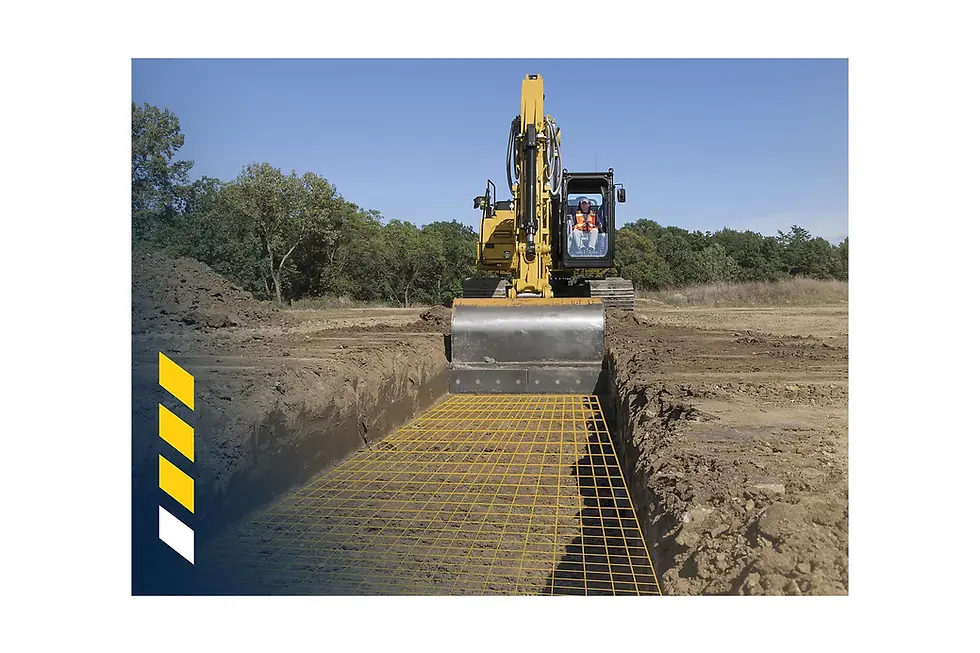
On top of both tiers sits Grade with Assist, which moves from guidance into semi-autonomous digging. An operator running Grade with Assist can control boom, bucket, swing, and tilt functions with a single lever while the system handles the rest of the coordinated movement needed to hit the target surface. It's the difference between a system that tells you you're off grade and a system that's actively helping you get there.
Deciding Between 2D and 3D Isn't Always Obvious
A lot of contractors assume 3D is simply the better system and 2D is the budget option, but the right choice actually depends on the job mix more than the budget. A utility contractor cutting long, straight trench runs to a consistent slope doesn't necessarily need a full digital design file and satellite positioning, a 2D laser-guided system handles that work well at a lower cost to equip and maintain. Where 3D earns its premium is on complex sites with varying elevations, multiple building pads, or designs that come from an engineer as a digital file rather than a simple slope and offset. If your bid list is mostly straightforward utility and grading work, 2D may be the smarter first investment, with 3D reserved for the excavator or dozer that handles your more complex sitework.
The In-Cab Hardware Contractors Actually See
Day to day, the system shows up as an in-cab touchscreen interface with jog dial controls on the 2D setup, and a higher-resolution touchscreen monitor on the 3D version. CAT Grade also connects into VisionLink, Caterpillar's cloud telematics platform, as an optional subscription layer, which lets an office manager check which machines are running grade jobs and how they're performing without a site visit. That's worth knowing if your operation is already running VisionLink for fleet tracking, because the grade data rides the same pipe instead of requiring a separate system to manage.

What This Actually Buys a Contractor
It's easy to list features and skip past why they matter financially, so here's the direct version. Grade control cuts the number of passes it takes to hit a target surface, because the operator isn't guessing and re-checking with a grade rod every few minutes. Fewer passes means less fuel burned per cubic yard moved and less operator fatigue over a ten-hour day. More importantly, it cuts material waste on both ends: over-cutting a pad means importing fill to bring it back up, and under-cutting means recutting later. Either mistake costs real money on a bid that was already tight, and grade control is specifically built to keep both from happening.
There's a safety angle that's easy to overlook too. Traditional grade checking puts a laborer on the ground near a swinging excavator or a moving dozer blade, checking elevations while the machine is working close by. A machine running 3D grade control needs far fewer of those ground checks, which means fewer people standing in the machine's working radius during the riskiest part of a cut.
Training an Operator on Grade Control Pays Off Fast
One underrated part of adding grade control is how quickly a mid-level operator can become productive with it. Precision grading used to be the domain of your most experienced operator, the person who could read a string line and feel their way to an elevation. Grade control narrows that skills gap, letting a newer operator hit the same tolerances a veteran would without years of seat time. For contractors dealing with the ongoing shortage of experienced equipment operators, that's not a minor benefit, it's a way to get more jobs staffed without being bottlenecked on finding the one person who's good enough to run a precision grading job the old way.
Who This Actually Matters For
Site development contractors cutting pads for commercial buildings, utility contractors trenching to precise invert elevations, foundation and footing subs working tight tolerances, and road and parking lot builders grading base course all have a direct stake in this technology, because all of them get paid on how close they land to a target elevation, not on how many hours they spent getting there. A contractor running grade control on an excavator or dozer can credibly bid tighter tolerances and faster timelines than one running string lines and a grade rod, and on a competitive bid list, that difference shows up in who wins the job.
This Isn't New Technology, It's Matured Technology
It's worth being straight about one thing: machine grade control isn't a brand-new idea. Caterpillar and other manufacturers have offered some form of laser and GPS-guided grading for well over a decade, evolving from indicate-only laser setups into the fully integrated 3D GPS and semi-autonomous assist systems available today. What's changed isn't the basic concept, it's how deeply integrated, how affordable at the entry tier, and how connected to fleet telematics the current generation is. A contractor evaluating CAT Grade today isn't looking at an experimental add-on, they're looking at a mature system that's had years of real jobsite refinement behind it.
Financing the Machine, Not Just the Tech
Here's where this connects directly to how a contractor actually gets this capability onto their jobsite: grade control usually comes bundled on the excavator or dozer itself, factory-installed, rather than as a standalone purchase. That means the decision to add grade control is really a decision about which machine to finance, and it changes the math on that machine's value to your business. A dozer or excavator with 3D grade control isn't just moving dirt, it's opening up bid opportunities on jobs with tight elevation tolerances that a string-line crew can't competitively chase.
That's a strong argument for financing the machine instead of renting a grade-control-equipped unit job by job. Rental yards that stock grade-control machines charge a real premium for that capability, and every one of those rental invoices is money gone for good on a tool you'll need again on the next pad-grading job. Financing a dozer or excavator with CAT Grade built in means the capability is sitting on your yard every morning, ready for the next bid, instead of something you have to source and pay a premium for each time a job calls for it. BFC finances this equipment for contractors nationwide, startups and established businesses, with credit profiles across the board, and structures the deposit to fit where your business actually stands rather than a flat, one-size requirement.
Compare the Machines That Carry This Technology
If you're deciding which excavator or dozer to put grade control on, it's worth seeing how the base machines stack up against the competition first. BFC has compared the CAT 416 against John Deere's 310 P-Tier backhoe loader, broken down CAT's D9 against John Deere's 1050K in the large dozer class, and looked at how Hyundai's HD100 compares to the CAT D3 for smaller sitework jobs. Any of these platforms can carry CAT Grade equipment, and knowing the base machine's strengths helps you decide where the technology adds the most value for your specific work.
Equipment Financing That Keeps Pace With Your Bid List
Grade control technology is a real differentiator on a bid sheet, but only if the machine carrying it is actually on your site when the job comes up. Equipment financing through BFC is built to get that machine into your fleet without draining the cash you need for the project itself, whether you're adding your first grade-control-equipped excavator or replacing an aging dozer that's starting to cost more in downtime than it's worth.



Comments