

Inside Caterpillar's Peoria Proving Ground: Why a Scraper Gets Six Years of Testing Before It Reaches You
Updated: Oct 6
A new CAT machine doesn't go from drawing board to dealer lot in a year. For the 637K tractor scraper, the process took six years, and most of that time was spent at a 2,600-acre property outside Peoria, Illinois where photography is banned, visitors wear steel-toed boots and taped-over phone cameras, and engineers spend years deliberately trying to break machines before a customer ever gets the chance to.
The Machine Development Center: An Indoor Arena With Its Own Weather
The centerpiece of Caterpillar's Peoria Proving Ground is the Machine Development Center, a 150,000-square-foot indoor testing arena holding 3.4 acres of dirt under a 41-foot roof, with up to 50 feet of excavatable dirt beneath the machines for digging simulations. The scale exists so Caterpillar can fully simulate load-and-dump cycles without running out of room overhead, and the arena is heated, which sounds like a comfort feature until you learn why: engineers can heat the floor to 95 degrees in the middle of an Illinois winter to run a cooling-system test that would otherwise require shipping a prototype to Arizona and waiting for the right weather.
How a Machine Actually Gets Built: The 637K's Six-Year Path
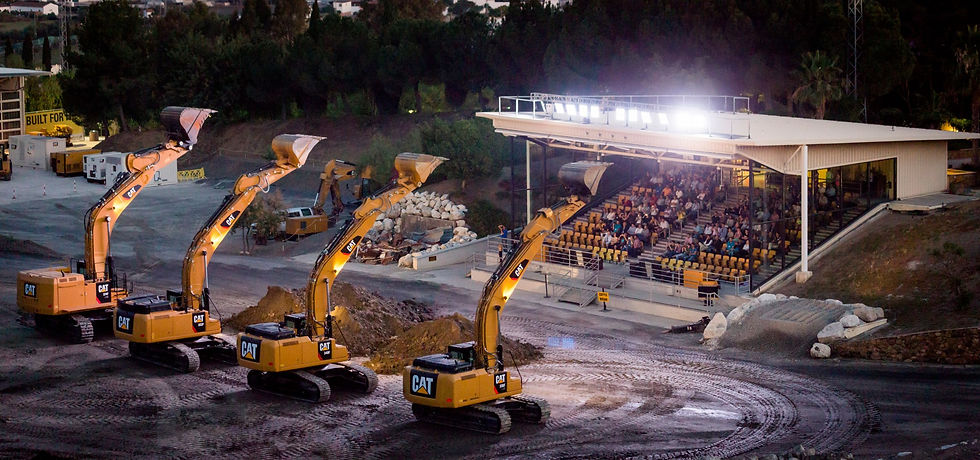
Caterpillar let Equipment World document the development of the 637K wheel tractor-scraper in detail, and the timeline is worth knowing. Discussions started in 2010 with customer interviews: what owners liked about the outgoing G-Series, what should change, what features from other machine types they wanted carried over. A proof-of-concept machine followed that same year, described by the engineer who ran it as deliberately "rickety" and wire-covered, built purely to prove a concept worked before anyone committed to a production design. Three pilot machines arrived at the MDC in mid-2013, each wired with more than 300 strain-gauge sensors monitoring the frame, spindles, bowl, and pins under real load. By the time Caterpillar showed a journalist the pilot unit in 2016, it had 1,100 hours on it, an early number for a scraper class the company expects to run for 60 years, and the paint had worn off from being taken apart and reassembled so many times.
Testing the Machine Against Itself, Then Against Its Predecessor
Before engineers even get to durability testing, they validate that the machine's own computers can talk to each other reliably, the aftertreatment system, the transmission, the hydraulics, and the main control system each run their own onboard computer, and a software fault in any one of them can take down the whole machine. Once that's solid, Caterpillar runs its in-house operators head-to-head: the new 637K against the outgoing 637G, in the same applications, back to back, to get a real production-figure comparison rather than a marketing estimate. Only after that does a couple of pre-production units go out to actual customers on real jobsites, each one carrying a black box called a Super Comm 2 that streams system pressures, currents, fan speeds, engine speeds, and acceleration data back to engineers in real time throughout the field trial.
The Edwards Demonstration and Learning Center: Testing That's Actually Open to Customers
The Peoria Proving Ground itself is closed to the public, but Caterpillar's nearby Edwards Demonstration & Learning Center, set on 720 acres of Illinois prairie, is the public-facing version of the same idea. For more than 50 years it's let contractors see, test, and run CAT equipment firsthand before they buy, rather than taking a spec sheet and a dealer's word for it. That's a meaningfully different sales relationship than most equipment brands offer, and it exists specifically because Caterpillar treats letting a buyer run the machine themselves as part of the validation process, not just a marketing perk.
Why This Matters to a Financed Machine Specifically
A six-year validation cycle with hundreds of sensors and multi-year field trials is the reason a CAT machine tends to hold up through a long financing term without surprise failures that wreck a budget mid-loan. It's part of the same reliability story behind our breakdown of CAT Certified Rebuild, a program that only makes financial sense because the underlying machines are engineered to be worth rebuilding in the first place. It also connects directly to the resale and maintenance discipline we cover in protecting your equipment's resale value: a machine built to this standard, maintained well, holds its value in a way that makes the financing math work better on both ends of the loan.

Financing the Machines That Earned Their Reliability
BFC finances the full range of Caterpillar excavators and the rest of CAT's current lineup, for startups and established businesses, nationwide, with good credit or credit that's taken a hit. The years of testing behind a machine are exactly the kind of thing that make financing it a lower-risk decision than it looks on paper.
Ready to finance your next CAT machine? Visit our homepage | apply for equipment financing | browse equipment for sale | subscribe to our newsletter



Comments