

The Overlooked Machine: New Holland's ML35T and ML50T Small Articulated Telescopic Loaders
The Loader Nobody's Talking About
Walk through almost any conversation about compact loaders in construction and the names that come up are wheel loaders, skid steers, and compact track loaders — rarely small articulated loaders, and almost never New Holland's ML35T and ML50T. That's a little strange, because these two machines solve a real problem a lot of smaller contractors run into: needing to load over the side of a dump truck box, work in a tight space, and still get real lift height — without stepping up to a full-size wheel loader that's overkill for the job and a pain to maneuver on a cramped site.

New Holland's Quiet Entry Into Small Articulated Loaders
New Holland and sister company Case entered the small articulated loader category in 2023 through an agreement with Tobroco-Giant to build the machines, and the ML35T and ML50T are the telescopic-boom versions of that lineup — the “T” in the model name stands for telescopic. These aren't brand-new-this-year announcements; they've been available since their original release, which is part of why they fly under the radar compared to splashier new wheel loader and skid steer launches. But for the contractors who actually need what they do, that's beside the point — these are proven machines, not unproven ones, and the lack of hype doesn't mean a lack of capability.
The Tobroco-Giant Partnership Behind the Build
It's worth contractors knowing that the ML35T and ML50T aren't built from the ground up by New Holland's own engineering team the way a wheel loader or compact track loader would be — they're built under New Holland and Case's 2023 agreement with Tobroco-Giant, a manufacturer that's been building small articulated loaders for the European market for years before this partnership brought the design to North America under the New Holland badge. That's not a knock on the machine; it means New Holland is leaning on a manufacturer with a long track record in this specific category rather than starting from scratch, and it's a common arrangement in construction equipment when a brand wants to enter a category quickly without years of in-house development. Parts and service for these models route through the standard New Holland dealer network regardless of where engineering originated.
What “Telescopic” Actually Buys You
The defining feature on both models is a telescopic boom that extends and retracts to any length as needed, rather than being locked into a fixed reach the way most compact loaders are. Combined with a lifting height just over 14 feet on both machines — which New Holland says is the highest in the industry for their class — that telescoping reach means these loaders can genuinely load over the sideboards of a dump truck box without creeping the bucket up inch by inch and hoping it clears. For a landscaping outfit, a small excavation contractor, or a property maintenance crew loading mulch, gravel, or debris into waiting trucks all day, that difference in reach changes how many passes a job takes.
How It Compares to a Compact Track Loader or Skid Steer
For a contractor who already owns a skid steer or compact track loader, the natural question is why add a small articulated loader at all instead of just buying a bucket attachment for the machine already on the lot. The answer comes down to reach and stability on uneven ground. A skid steer's fixed-boom geometry and rigid frame can't match the ML35T or ML50T's telescoping reach or the ride comfort of an articulated chassis with a front oscillation joint, especially over rougher terrain common on residential lots mid-construction. The tradeoff runs the other way too — a skid steer or CTL still wins on raw digging power with the right attachment and tends to have a lower upfront cost. The two categories complement each other more than they compete, and plenty of landscaping and property-maintenance fleets end up running both.
Zero-Cab-Swing Design and the Front Oscillation Joint
Both the ML35T and ML50T are built with what New Holland calls a zero-cab-swing design, a result of how the rear articulation and front oscillation joint are engineered. The operator sits closer to the front of the loader than on a conventional articulated loader, which improves stability and lets the operator work closer to walls, fences, and other obstacles in tight spaces without the cab swinging into them during a turn. The front oscillation joint itself lets the front axle move independently of the rear axle, keeping all four wheels on the ground even on uneven terrain — a detail that matters more than it sounds like on a site with ruts, slopes, or loose fill, where a rigid axle setup can lift a wheel and tip the balance of the load.
ML35T and ML50T: The Numbers
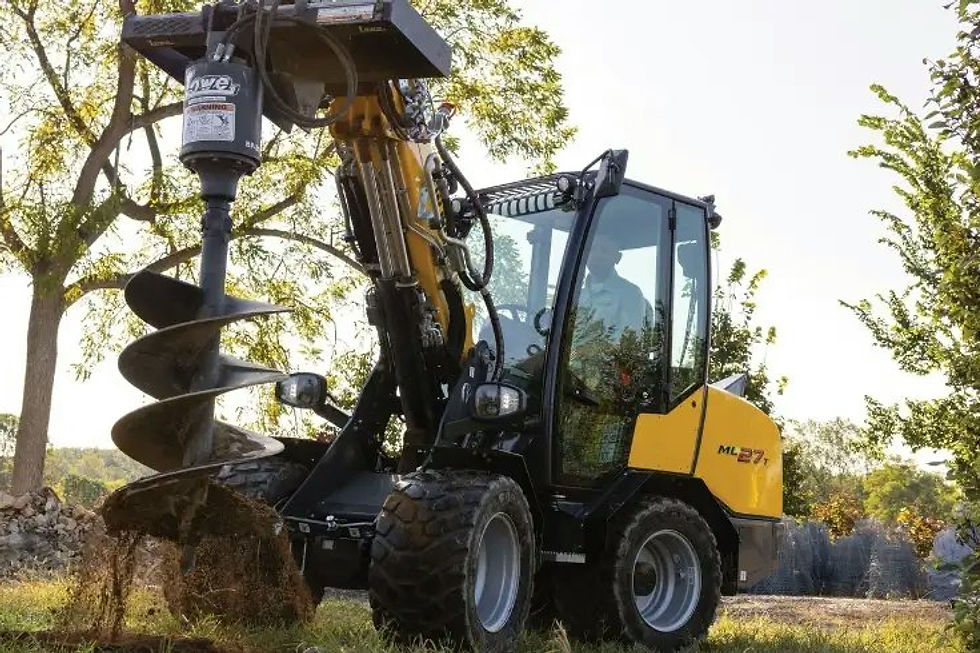
The ML35T runs a Kubota 65-horsepower engine and weighs in at 8,818 pounds operating weight, with a lift height of 169.9 inches and lift capacity ranging from 1,630 to 5,510 pounds depending on boom position. It's 52.8 inches wide, narrow enough to work through gates and tight side-yard access that would stop a wheel loader cold. Step up to the ML50T and horsepower climbs to 74 on the same Kubota platform, operating weight increases to 11,464 pounds, lift height goes to 171.3 inches, and lift capacity ranges from 2,780 to 6,170 pounds. Width grows slightly to 57.5 inches — still compact enough for most residential and light commercial access points.
Built for More Than One Job
Both machines are designed to run a wide range of attachments — New Holland describes the range as running “from sweepers to snowblowers” — which matters for a contractor trying to get year-round use out of one machine instead of parking it every winter. A climate-controlled cab, an adjustable seat, steel plates and reinforced booms for durability, ground-level service points to cut down on maintenance time, an ISO-standard attachment coupler for quick changeovers, ROPS/FOPS certification, a backup alarm, a rotating beacon, and road light kits round out the package. None of that is flashy, but all of it is what a contractor actually asks about before buying — can I service it easily, can I run my attachments on it, and can I drive it between job sites without a separate light kit.
Seasonal Versatility Matters More Than the Spec Sheet Suggests
One detail easy to overlook on a spec sheet: New Holland specifically markets these loaders as running “from sweepers to snowblowers,” which positions the ML35T and ML50T as genuinely four-season equipment rather than a machine that sits idle half the year. For a landscaping or property maintenance contractor weighing the cost of a dedicated piece of equipment against one that earns its keep loading mulch and gravel in spring and summer, then switches to a snowblower or broom attachment for winter plowing and sidewalk clearing contracts, that year-round utilization changes the economics of ownership in a way a single-season loader or skid steer attachment setup can't match.
Who Should Actually Be Looking at These
The ML35T and ML50T aren't going to replace a wheel loader on a large-scale grading job, and they're not trying to. Where they make sense is smaller-footprint work: landscaping and hardscape contractors loading material into trucks on residential and light commercial sites, property maintenance and snow removal operations that need one machine to run attachments year-round, and small excavation or utility contractors who need real lift height and reach in spaces too tight for a wheel loader to maneuver. If your jobsites regularly involve loading over truck sideboards in confined areas, this is a category worth a serious look — even though it's been quietly available for a while rather than freshly announced. For a look at how New Holland's wheel loaders compare on parts support against a competing brand, see our breakdown of New Holland vs. Hyundai wheel loader parts availability, and our spotlight on the New Holland W70D and W80D D-Series compact wheel loaders if you're comparing it against a conventional compact wheel loader.
What to Ask a Dealer Before You Buy
Because this is a newer category without the decades of resale data behind a wheel loader or skid steer, a few questions are worth asking a New Holland dealer directly before committing: how many of these units has the dealer actually sold and serviced in your region, what's the realistic parts lead time on telescoping boom components specifically, and how does trade-in value look for this category compared to a comparable compact wheel loader after several years of use. None of those questions should scare a buyer away from the ML35T or ML50T — they're legitimate, well-engineered machines — but going in with real answers on dealer support beats assuming it matches a more established equipment category by default.
Financing an Overlooked Machine: Rent or Own?
Because small articulated loaders like the ML35T and ML50T are a newer category without decades of resale history behind them, financing decisions should lean on how the machine fits your actual workload rather than assumptions carried over from wheel loaders or skid steers. If your crew needs this kind of reach and maneuverability on a recurring basis — landscaping outfits running multiple residential jobs a week, for example — equipment financing to purchase makes sense, since you're using the machine constantly and building equity instead of renting the same capability over and over. If the need is occasional — a one-off job requiring that extra reach in a tight space — a rental or short lease avoids tying up capital in a machine that might sit idle between jobs. A wheel loader equipment financing package can usually be structured the same way for a small articulated loader like this one.
Bottom Line
The New Holland ML35T and ML50T solve a specific, real problem — lift height and reach in a package small enough to work where a wheel loader can't — and they've quietly been doing it since their original release without much fanfare. If one of these overlooked machines fits a gap in your fleet, or you're weighing a small articulated loader against a compact wheel loader for the same job, BFC Equipment Loans works with landscaping, property maintenance, and small excavation contractors nationwide on financing built around how the machine will actually be used.


Comments