

ROPS, Seat Belts, and the ANSI/ROHVA Standard: What Actually Keeps a Kubota RTV or John Deere Gator Operator Safe
Every UTV comparison we've run, the diesel RTV-X1140 against the XUV865M, the Sidekick against the XUV835M, even our parts and dealer network breakdown, skips past one question contractors genuinely ask before putting a crew member behind the wheel: what actually keeps someone safe on one of these things if it rolls? Neither Kubota nor John Deere builds a UTV under the same federal motor vehicle safety standards that govern your work truck, and understanding why, and what does apply instead, matters more than most buyers realize.
Why a UTV Isn't Regulated Like a Truck
Utility vehicles and the broader recreational off-highway vehicle, or ROV, category sit outside the National Highway Traffic Safety Administration's motor vehicle safety standards, the same rules that mandate airbags, specific crash structures, and crash-test ratings on your pickup. The U.S. Consumer Product Safety Commission looked at writing a mandatory federal safety rule specifically for ROVs, and instead chose to rely on an industry-developed voluntary standard rather than finalize its own mandatory regulation. That voluntary standard is ANSI/ROHVA 1, maintained by the Recreational Off-Highway Vehicle Association, an ANSI-accredited standards developer. The current version is ANSI/ROHVA 1-2023, the latest in a line that started with the 2010 edition.
What that means in plain terms: there's no government-mandated crash test a Kubota RTV or a John Deere Gator has to pass before it reaches a dealer lot. Both manufacturers build to the voluntary ANSI/ROHVA 1 standard anyway, because it's become the de facto baseline the entire industry, dealers, insurers, and safety advocates all measure against, but it's an industry commitment, not a federal mandate, and that distinction is worth understanding before you assume a UTV carries the same regulatory safety floor as the dump truck parked next to it.
What ANSI/ROHVA 1 Actually Covers
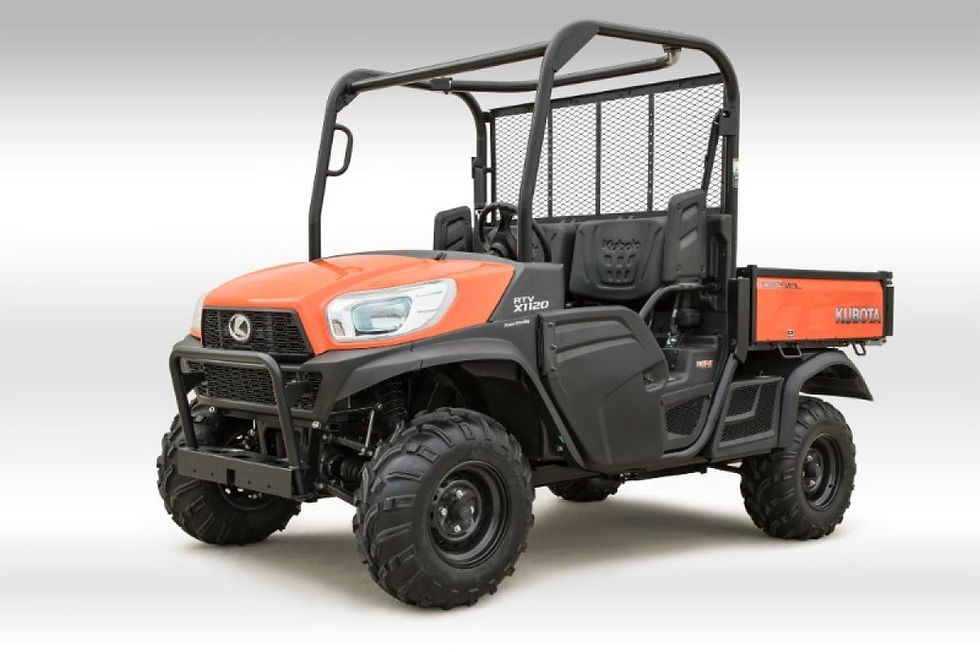
The standard addresses a wide list of design and performance areas: accelerator, clutch, and gearshift controls, lighting, tires, service and parking brake performance, lateral and pitch stability, occupant handholds, labels and owner's manuals, and two items that matter most in a rollover scenario specifically: the Rollover Protective Structure, or ROPS, and the Occupant Retention System, or ORS, which covers seat belts and any additional retention hardware like nets or doors. Both Kubota's RTV line and John Deere's Gator XUV line ship with a ROPS cage as standard equipment and a seat belt as part of the occupant retention system, consistent with what the voluntary standard calls for across the industry.
Rollover Is the Risk the Standard Is Actually Built Around
Lateral and pitch stability testing exists in ANSI/ROHVA 1 for a specific reason: a UTV's biggest real-world injury risk isn't a head-on collision, it's a rollover, whether from a side slope, a sudden direction change at speed, or an edge the operator didn't see. That's exactly why the ROPS cage and the seat belt work together as a system rather than as two independent features. A ROPS cage without a fastened seat belt doesn't protect an ejected occupant, and a seat belt without a ROPS cage doesn't protect an occupant from a cage-less rollover. Neither Kubota nor Deere publishes a specific independent load rating for their ROPS structures the way some competitive marketing materials imply exists, both build to the same voluntary industry standard's performance requirements rather than a brand-specific, publicly comparable number.
What that means for a buyer: this isn't a spec you can meaningfully cross-shop the way you'd cross-shop horsepower or towing capacity. Both the RTV line and the Gator XUV line are built by established manufacturers with every incentive to meet or exceed the voluntary standard, and the honest answer is that the real safety variable on your jobsite isn't which brand's ROPS cage is marginally stiffer, it's whether your crew is actually buckling the seat belt every time, every operator, every trip.
The Human Factor: Seat Belt Discipline on a Multi-Operator Machine
A UTV gets handed around a jobsite in a way a dedicated-operator excavator doesn't. A superintendent drives it in the morning, a laborer drives it at lunch, a visiting inspector drives it in the afternoon. That rotation is exactly where seat belt discipline breaks down, because nobody feels like "the operator" of a machine they're borrowing for ten minutes. Both Kubota and Deere equip their UTVs with the retention hardware the ANSI/ROHVA standard calls for, but hardware doesn't buckle itself. If you're running either brand on a site with rotating drivers, building a simple seat belt rule into your site safety orientation costs nothing and addresses the actual leading cause of serious UTV injury far more directly than any spec-sheet comparison does.

Why the Recall History Matters Here Too
Steering and suspension defects compound rollover risk directly, which is why we flagged it separately in our coverage of the 2025 Kubota RTV-Series ball joint recall. A ball joint defect that can cause loss of steering control doesn't just create a handling problem, it creates exactly the kind of sudden, unplanned direction change that lateral stability testing and ROPS design are meant to survive, but shouldn't have to be tested against in the first place. If you're buying a used RTV, confirming open recalls are addressed is a genuine safety step, not paperwork busywork.
Public Roads Add a Second Layer of Risk Entirely
Some contractors run their RTV or Gator strictly inside a fenced jobsite. Others cross a public road to get between parcels, or run short stretches on a rural route between a yard and a work front. The moment a UTV touches a public road, state law, not the ANSI/ROHVA standard, becomes the operative safety framework, and those laws vary significantly from state to state on lighting, mirrors, turn signals, and whether the machine is street-legal at all. We covered the state-by-state side of that question in detail in our piece on UTV road-legal requirements by state, and it's worth treating as a separate safety conversation from ROPS and seat belts, because a machine that's perfectly compliant with the voluntary industry safety standard can still be operating illegally, and more importantly unsafely around actual highway traffic, the moment it's on a public road without the right lighting and visibility equipment for that state.
Insurance and Liability: Why Safety Features Aren't Just a Compliance Checkbox
A rollover injury on a jobsite UTV isn't just a safety event, it's a workers' compensation claim, a potential OSHA inquiry if the injured party is an employee, and in a worse scenario, a liability question your general liability or equipment insurance carrier is going to ask pointed questions about. Insurers increasingly ask contractors directly whether jobsite UTVs have a functioning ROPS and whether seat belt use is part of the written site safety plan, not because either brand is deficient, but because the answer to that question affects how a claim gets evaluated. Building seat belt use into your actual written safety orientation, the same way you'd document fall protection training, gives you something concrete to point to if an incident ever does happen, regardless of which brand's machine was involved.
Buying New, Training Your Crew, and Owning vs. Renting
A rental UTV from a yard you've never dealt with before is a machine your crew has no familiarity with, no seat position memory, no sense of where the ROPS cage sits relative to a low doorway, and often a rental counter that doesn't walk through a safety briefing the way a dealer selling you a UTV for your own fleet typically will. Owning the same unit for years means your crew actually knows the machine: where the seat belt buckle sits, how the cage feels in a tight space, what the machine does on a side slope before it becomes a problem. That familiarity is a genuine safety advantage of ownership that rarely gets mentioned next to the financial case for owning over renting, but it's real.
Trades That Should Care Most About This
Every trade running a UTV should care about seat belt discipline, but some operations carry materially more rollover exposure than others. Highway and utility right-of-way crews working UTVs along graded shoulders and drainage ditches, land-clearing and forestry-mulching operations running across uneven, recently-cleared ground, and solar-site and large-campus earthwork crews covering acreage with temporary grading and stockpiles all put a UTV on exactly the kind of inconsistent, sloped terrain that lateral stability testing exists to address. A roofing or remodeling contractor using a UTV mostly on a flat, paved driveway faces a meaningfully lower version of this same risk, but the hardware, and the seat belt habit, matter for both.
What to Verify Before You Buy, New or Used
On a new RTV or Gator, confirming ROPS and seat belt equipment is straightforward, it's standard on both lines and shown in the dealer's walk-around. On a used unit, it's worth confirming nothing has been modified or removed, since a previous owner occasionally strips a cage for a specific low-clearance task and doesn't always reinstall it correctly, or at all. Ask the selling dealer directly whether the ROPS structure is original and undamaged, and physically check the seat belt hardware yourself rather than assuming a used listing's photos tell the whole story. Combined with the recall check mentioned above, that's a five-minute inspection that meaningfully reduces your actual risk exposure on a used purchase.
UTV Equipment Financing That Accounts for the Whole Picture
Whether you're financing a Kubota RTV or a John Deere Gator, the safety equipment riding on it, ROPS, seat belt, and the voluntary standard both brands build to, is part of what you're buying, even though it rarely shows up on a comparison chart next to horsepower and towing capacity. Review our Kubota equipment financing and John Deere equipment financing pages, and if hauling capacity matters as much to you as safety does, go back to our RTV-X1140 vs. XUV835M comparison for the full spec picture before you commit to either brand.
Whichever side of this you land on, BFC Equipment Loans structures financing for both the Kubota RTV line and the John Deere Gator lineup, nationwide, not just for the excavator or the track loader sitting next to it on the invoice. Head back to our home page to see the full scope of what we finance, browse our current equipment for sale and financing inventory, or go straight to the equipment financing application if you already know which machine you want. And if you want more honest, spec-driven breakdowns like this one in your inbox, subscribe to the BFC blog.



Comments